
What to Look for When Buying Land: A Guide to Land Investment
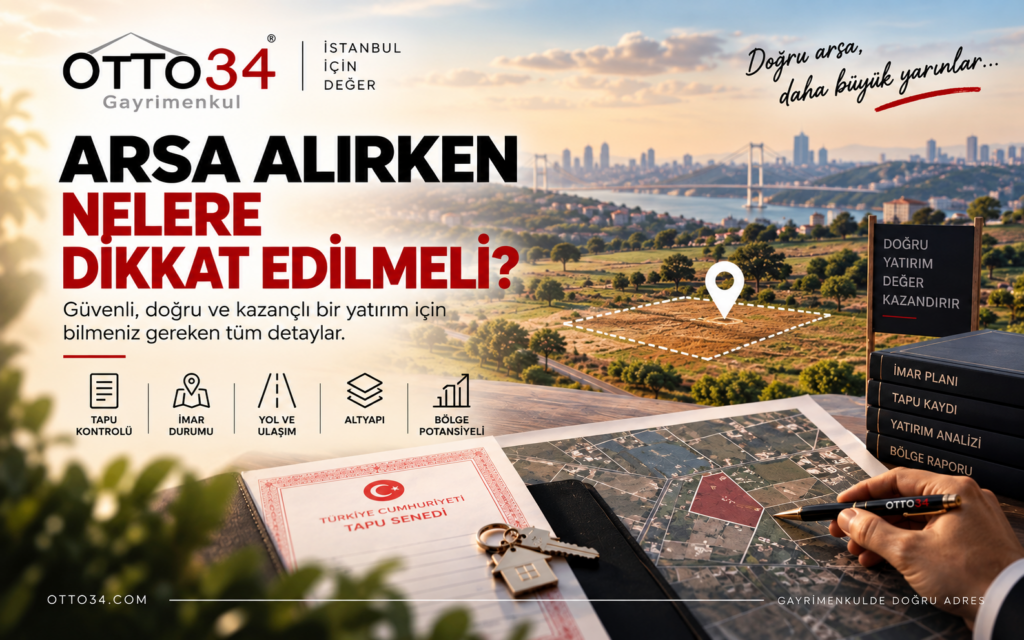
What to look for when buying land comes down to 13 checks that need to be weighed together, from the title deed and zoning status to the floor area ratio, encumbrances, road frontage and infrastructure. Land investment is one of the types of real estate investment that can deliver significant appreciation over the long term when the right location and the right property are chosen. However, the fact that a plot’s location or price looks attractive does not, on its own, mean it is a good investment.
Before buying a plot of land, many factors need to be evaluated together, from title deed (tapu) records to zoning status (imar durumu), from building conditions to road frontage, and from infrastructure to the area’s growth potential.
The technical terms used in zoning plans in particular can be confusing for first-time land investors.
What is emsal (floor area ratio)? What do TAKS and KAKS mean? Can you build a house on a tarla (agricultural field)? Should you buy a plot that has no cadastral road access? Is a shared title deed (hisseli tapu) risky?
In this guide, we walk you step by step through what to look for when buying land.
1. Check Whether the Title Deed Lists the Property as a Building Plot or a Field
One of the first things to check is the classification of the property on the title deed.
Although any vacant piece of land may be called an “arsa” in everyday speech, legally an arsa (building plot) and a tarla (agricultural field) are not the same thing.
Nor does the fact that a property is registered on the title deed as an arsa mean that the desired building can be constructed on it straight away.
For this reason, looking only at the classification on the title deed is not enough. The property’s
- current zoning status,
- plan function (designated land use),
- building conditions,
- plan notes, if any,
should also be examined separately.
2. Verify the Block and Parcel Details
When buying land, rather than relying solely on the location you are shown, it is important to verify the property using its block and parcel (ada and parsel) details.
The Parcel Inquiry System (Parsel Sorgu) provided by the General Directorate of Land Registry and Cadastre (TKGM) is one of the key official resources you can use at this stage.
TKGM Parcel Inquiry:
https://parselsorgu.tkgm.gov.tr/
By running a search with the block and parcel details, you can review the property’s location on the map, the parcel geometry and various basic information provided in the system.
It is especially useful at the initial evaluation stage for comparing the land you are shown with the location of the parcel on the title deed.
However, the information displayed on Parcel Inquiry should not, on its own, be treated as a zoning status document or a certificate of development rights. Before making a purchase decision, up-to-date official information should also be checked with the relevant municipality and other competent authorities.
3. Always Research the Plot’s Zoning Status
One of the most critical issues in land investment is zoning status.
What a parcel can be used for is determined by the relevant zoning plans and plan provisions.
A parcel may be designated as a
- residential area,
- commercial area,
- commercial + residential area,
- industrial area,
- tourism area,
- social or technical infrastructure area,
among other land-use designations.
Two parcels in the same area, even right next to each other, may have different building conditions.
That is why it is wrong to conclude that “The same building can be built here too” just by looking at the surrounding buildings.
The current zoning status of the specific block and parcel you plan to buy should be researched.
4. Check the Floor Area Ratio (Emsal), TAKS, KAKS and Building Height
For a zoned plot, simply knowing that it is “zoned for residential use” or “zoned for commercial use” is not enough information.
How much can be built directly affects the investment value.
What Is Emsal (KAKS)?
Emsal (floor area ratio, also referred to as KAKS) is, in general terms, the building coefficient used to determine the total construction area counted toward the emsal that can be built on a parcel.
Using a simplified example:
1,000 m² plot × 1.50 emsal = 1,500 m² of construction area counted toward the emsal
However, this calculation alone does not show the final project area.
Plan notes, areas excluded from the emsal calculation, setback distances, TAKS, height, parking requirements and other plan provisions can change the actual project capacity.
What Is TAKS?
TAKS (building coverage ratio) is one of the building conditions relating to the ground area that a building may cover on the parcel.
As a result, two plots with the same emsal can turn into completely different projects because of differing TAKS values or other building conditions.
What Is Yençok / Hmax?
Yençok or Hmax, as seen on plans, refers to the rules on the building’s maximum permitted height.
If you are buying land for project development in particular, the number of floors, height and setback distances should be evaluated together with the emsal.
5. Don’t Overlook the Plan Notes
One of the most common mistakes in land investment is looking only at the basic information on the zoning status certificate.
Yet the plan notes of the zoning plan can directly affect the project that can be developed.
Plan notes may contain important details such as the permitted use, building conditions, minimum parcel size, setback distances or special conditions of use.
Especially for large-scale development plots, basing a price analysis on the emsal value alone is not enough.
Zoning status + plan notes + parcel geometry must be evaluated together.
6. Check the Title Deed for Annotations, Mortgages and Other Restrictions
Before making a purchase decision, the property’s current title deed records should be reviewed.
The title deed may carry entries such as
- mortgages (ipotek),
- attachments or liens (haciz),
- usufruct rights (intifa hakkı),
- easements (irtifak hakkı),
- annotations (şerh),
- declarations (beyan),
among others.
Some of these entries can directly affect the sale or the use of the property.
That is why, rather than settling for a copy of the title deed the seller obtained earlier, it is important to carry out the review using current title deed records.
7. Be Extra Careful When Buying Land with a Shared Title
If a parcel has more than one owner, it may be held under shared ownership (paylı mülkiyet).
For example, buying a 1/10 share of a 10,000 m² parcel does not mean you are the sole owner of a specific 1,000 m² section of the land.
The share on the title deed and the area actually used on the ground are two different concepts.
In addition, sales under shared ownership may raise legal issues such as the other co-owners’ statutory right of pre-emption (yasal önalım hakkı).
For this reason, the title structure and legal status should be evaluated separately when investing in land with a shared title.
8. Check the Plot’s Road Frontage and Access
The fact that a road physically runs alongside a parcel on the map may not mean that the parcel legally has the necessary road access.
Especially for land and plots outside the city, the question of cadastral roads (kadastro yolu) and zoning roads (imar yolu) should be researched carefully.
A parcel that lacks road frontage or has access problems can seriously affect the use of the property and its future project potential.
In addition, for purchases intended for project development, it matters whether any part of the parcel must be surrendered (terk) as a result of road widening or zoning implementations.
9. Examine the Parcel’s Shape and Physical Characteristics
What matters is not only how many square meters the plot is, but also what kind of parcel those square meters form.
Of two plots of the same size, one may have a regular rectangular shape while the other is very narrow, triangular or irregular.
In terms of
- building placement,
- setback distances,
- parking solutions,
- landscaped areas,
- project efficiency,
this difference can have a direct impact.
Especially for plots purchased for project development, parcel geometry, frontage width and depth should be evaluated together.
10. Research the Electricity, Water, Natural Gas and Sewer Infrastructure
Especially in newly developing areas, a reasonable land price may look attractive.
However, a lack of the necessary infrastructure in the area can affect the feasibility and cost of the project.
Before buying, the current state of the
electricity, water, sewer, natural gas, telecommunications and road infrastructure
should be researched as thoroughly as possible.
The future development of an area that is empty today can create a great investment opportunity. However, it is not wise to base an investment decision solely on the assumption that “it will definitely come eventually”.
11. Examine the Soil and Terrain
Especially for large plots on which a project will be developed, the physical characteristics of the land affect its economic value.
Sloping land can increase construction costs because of excavation, retaining structures and the design solutions required.
Similarly, ground conditions can also affect foundation and construction costs.
For large-scale investments, geotechnical surveys and technical assessments should, where necessary, be made part of the purchase decision.
12. Research the Area’s Future
In land investment, what the area will become in the future is just as important as its current state.
New transportation projects, metro lines, highways, industrial zones, logistics centers, universities or large housing projects can affect real estate values in an area.
However, there is an important distinction here:
An officially planned project and a rumor circulating in the area are not the same thing.
Claims such as “a metro line will run through here”, “this area will soon be opened up for development” or “a major project will be built in this area” should not become the basis of an investment decision unless they have been verified through official sources.
13. Don’t Compare Land Prices by Square Meter Alone
The fact that two plots are both 1,000 m² does not mean they must have the same value.
For example,
a plot with building conditions of 1,000 m², E:0.50 and
another plot with building conditions of 1,000 m², E:2.00
do not have the same development potential.
Location, zoning function, development rights, parcel shape, road frontage, infrastructure and sales values in the area should all be evaluated together.
Especially for development plots, what matters is not only the land price per m², but also the buildable construction area and the economic feasibility of the project.
What Should You Ask the Municipality When Buying Land?
Before buying land, it is important to obtain information that is as up to date as possible from the relevant municipality or competent authorities.
In particular, the following points can be researched:
- What is the parcel’s current zoning function?
- What is the emsal / KAKS value?
- Is there a TAKS requirement?
- What is the permitted building height?
- What are the setback distances?
- Do the plan notes contain provisions specific to the parcel?
- Does any part of the parcel have to be surrendered for a road or another public area?
- Is there a current or ongoing planning process affecting the parcel?
For major investment decisions, rather than acting on verbal information alone, it is sounder to carry out the review using official documents and current plans wherever possible.
The Most Common Mistakes in Land Investment
A large share of the problems in land investment stem from insufficient research before the purchase.
In particular, assumptions such as
“The area will definitely be opened up for development.”
“A building went up on the neighboring parcel, so one can be built here too.”
“It has a title deed, so there won’t be any problems.”
“It’s cheap compared to the surrounding area, so it’s bound to make money.”
should not, on their own, be the basis for an investment.
A good land investment usually comes not from rumors but from properly conducted technical, legal and economic due diligence.
Checklist Before Buying Land
Before making a purchase decision, you can use the short checklist below:
✓ Check the property’s classification on the title deed.
✓ Verify the block and parcel details.
✓ Review the parcel on TKGM Parcel Inquiry.
✓ Check the current zoning status.
✓ Read the plan notes.
✓ Find out the emsal, TAKS and building height.
✓ Check for annotations, mortgages, attachments and easements.
✓ Find out whether the title is shared.
✓ Check the cadastral and zoning road status.
✓ Evaluate the parcel’s shape and road frontage.
✓ Research the available infrastructure.
✓ Compare actual comparable sales in the area.
✓ Get technical and legal expert opinions for large investments.
Browse Our Land for Sale Listings
If you are considering a land investment, you can also browse the land for sale options in Otto34 Real Estate’s current portfolio.
Otto34 Portfolio:
https://otto34.com/portfoyler/
On the portfolio page, you can reach our current land listings by selecting the “Land” option in the filters on the left and explore options in different locations suitable for investment and project development.
From time to time, our portfolio includes plots suitable for residential development, commercial plots, industrial plots and land for long-term investment.
Land and Project Development with Otto34
Unlike a conventional home purchase, land investment requires analyzing not only today’s market value but also what the property could become in the future.
At Otto34 Real Estate, our land and project development work evaluates location, zoning conditions, development potential, real estate values in the area and the investment perspective together.
Especially when evaluating plots suitable for residential, commercial, industrial and project development, we go beyond the question:
“How many square meters?”
and focus instead on the more important question:
“What can be developed on this plot?”
That is the question at the center of our work.
To learn more about the sale, valuation or development potential of your land, you can get in touch with Otto34 Real Estate.
What to Look for When Buying Land: Frequently Asked Questions
What should you check first when buying land?
At the first stage, the title deed information, block and parcel, the property’s classification and current zoning status should be checked. After that, building conditions, encumbrances on the title deed (takyidat), road and infrastructure status and market value should be evaluated together.
Where can you run a block and parcel search?
Through the official Parcel Inquiry System of the General Directorate of Land Registry and Cadastre, you can use the block and parcel details to review the property’s location on the map and the basic parcel information provided in the system.
TKGM Parcel Inquiry:
https://parselsorgu.tkgm.gov.tr/
Should you buy unzoned land?
Unzoned property can be bought as an investment, but there is no guarantee that it will be zoned for development in the future. An investment decision should not rest solely on the expectation that the land will be opened up for development later.
What is the difference between a field (tarla) and a building plot (arsa)?
Arsa (building plot) and tarla (agricultural field) are properties with different legal classifications. However, the word “arsa” on the title deed does not, on its own, guarantee that the desired building can be constructed. The current zoning status and building conditions should also be checked.
Is buying land with a shared title risky?
Property with a shared title can be bought, but you should know that the share you purchase does not automatically correspond to a specific physical section of the land. Because of legal issues such as the co-owners’ rights and the right of pre-emption, a detailed review before the transaction is important.
Where can you find out a plot’s zoning status?
Zoning status can be researched with the relevant municipality or the competent authorities in the area where the property is located. Some information is also available through municipalities’ digital zoning systems. Investment decisions should be based on up-to-date, official information.
What does emsal 1.50 mean?
In a simplified calculation, a 1,000 m² parcel with a value of E:1.50 yields approximately 1,500 m² of construction area counted toward the emsal.
However, the final project capacity depends on the plan notes, TAKS, setback distances, height and other regulatory provisions.
Should you buy a plot with no cadastral road?
You can, but road access can significantly affect the use of the property and its development potential. For this reason, the legal and actual access situation should be examined in detail before buying.
What is the most important criterion in land investment?
There is no single criterion.
Location + zoning + development rights + access + parcel geometry + legal status + the right purchase price
should all be evaluated together.
This content has been prepared for general information purposes. Zoning plans, plan notes and legislation may differ depending on the property and the area. Before making a purchase or investment decision, it is recommended to obtain up-to-date information from the relevant official institutions and, where necessary, seek professional support from legal, surveying, urban planning and other relevant experts.